
- Published on

my seed cto notion system.
- Authors
- Name
- Amanda Southworth
2025 was certainly a year that happened. It was also a year that tested my limits as a CTO, in many ways.
Mostly, the role I have is definitely shifted. In December 2024, we closed our $3.5 million seed round and promptly set that money on fire to grow my team. At the beginning of 2025, I was 1/3 on the engineering team, 1/2 on the back-end, and 1/4 working at Faura. I was also the sole designer, product person, public documentation writer, and customer service contact.
In that time, we’ve had 2 people leave, 8 people join, 1 baby born, and have rebuilt almost every single part of our product — as well as developed more of an offering.
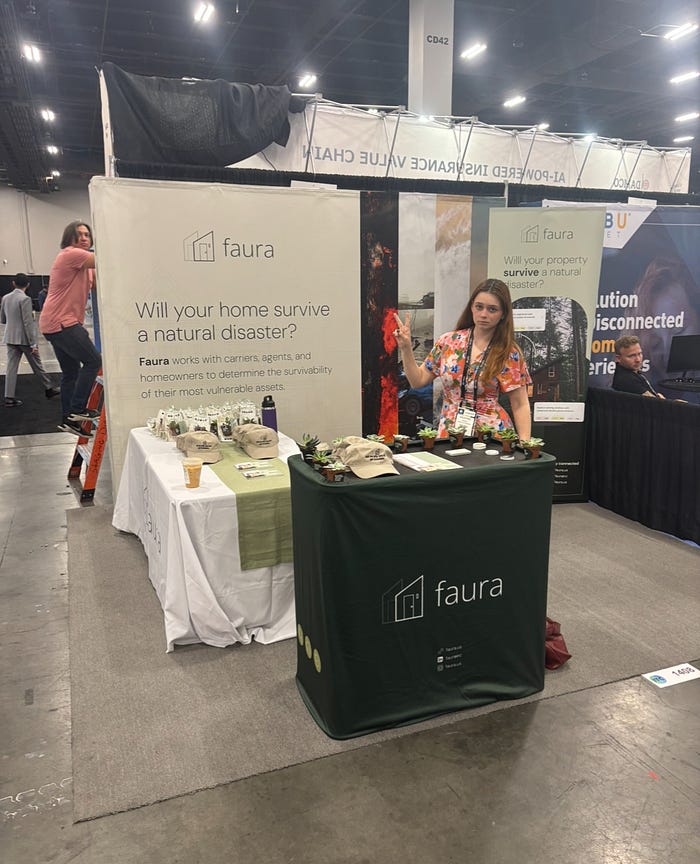
My job is more of a figurehead, but also in the details in many more ways than I would have anticipated. I am less of a programmer and more of a giant loudspeaker these days, often repeating company goals or communicating details across teams. I’m also often the first “explorer” into meeting new clients, forging new partnerships, scouting new people to join the company, and maintaining the face of what we do at conferences.
However, I also need to be ready to jump back in as an IC at any minute, like needing to be an understudy for an entire cast of a play.
There’s been some amazing parts of Faura that have scaled.
I work with the smartest and best people in the world. I truly believe that. My job is not to “manage” them, but to utilize them to take the knowledge they already have in a way that benefits us all.
There’s also been a lot of terrible shit that’s happened this year. Most of it, you will have to wait for my memoir to read. Many companies in our space have pivoted entirely out or have shut down and asked us to buy them. Our industry is intensely hard to survive in, which makes not drowning in it all paramount, and imminent.
My role has brought me everywhere, from Texas to Florida to living in London for 3 months. Now, I am living in New York City to be closer to my co-founder and to live out my startup dreams. But, as an autistic CTO, it’s been very hard for me to manage everything. It’s also just ass dealing with the constant amount of change and flexibility needed. Having a stable system to hold onto is sometimes the only way I can regulate.
I am a systems person, and the last thing startups often develop are systems. What I did over the holidays was build mine. It’s designed not only to organize everything for me, but to be extensible as jumping off points to share with the team, or to keep them functioning if I die tomorrow.
Our company will live and die by the knowledge we acquire, and failure to track and implement that knowledge is legitimately throwing money in the trash.
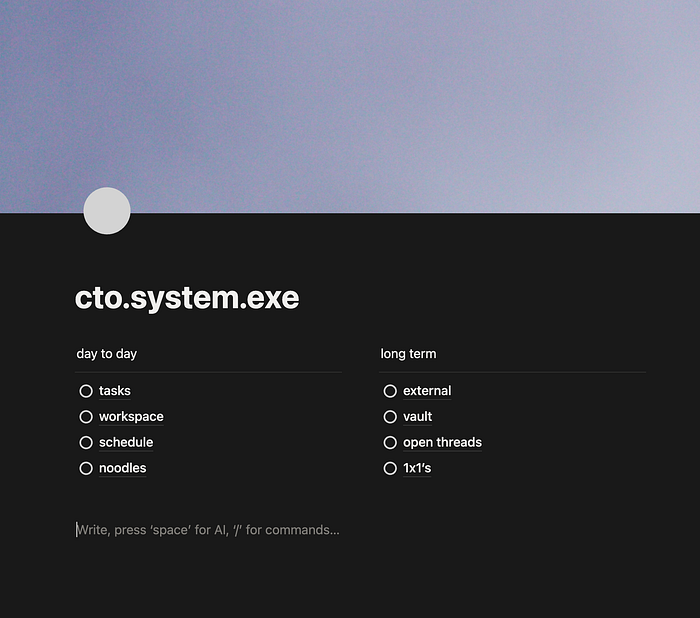
This is the high-level structure, it’s designed to be somewhat private, but also ready to be turned out into documents for the team or shared with people who need access to it. It’s meant to be easily ready to be taken over or to be read as an entire onboarding document. It’s my external brain, and the 20 days it’s been in production have been the most organized 20 days of my life.
— — —
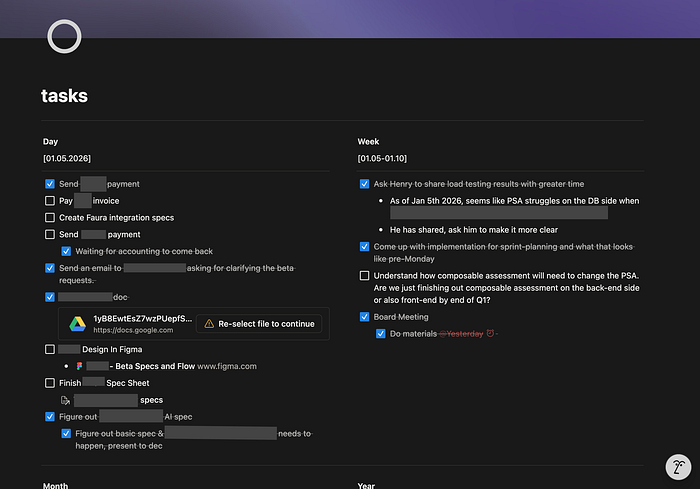
Tasks — Everything I need to oversee in a day, week, month, and year. I find this incredibly helpful to contextualize everything, and to keep things top of mind. It also feels less crushing to have things time chunked, because my to-do list without this [I have a separate task manager in Linear for programmatic tasks] would just be a long list of clusterfuckery.
Timeboxing keeps me focused on what’s important now, not everything that will be important (which is literally everything).
— — —
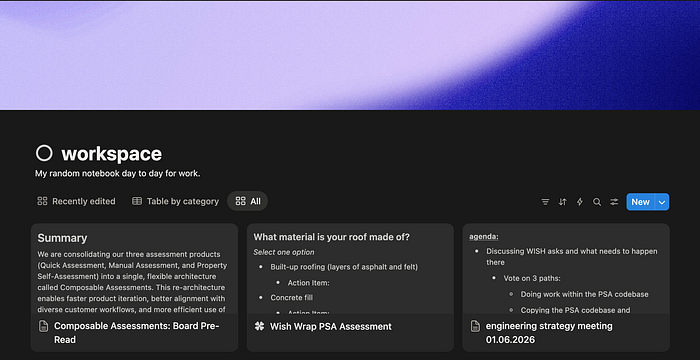
Workspace — My “notebook”, and where I start docs that need to be sent out to the team. This is the most chaotic space in the system, and often is where the seeds start for things that end up in Noodles, Vault, or open threads. These can also be documents that I share publically, like with our board or with external parties.
— — —
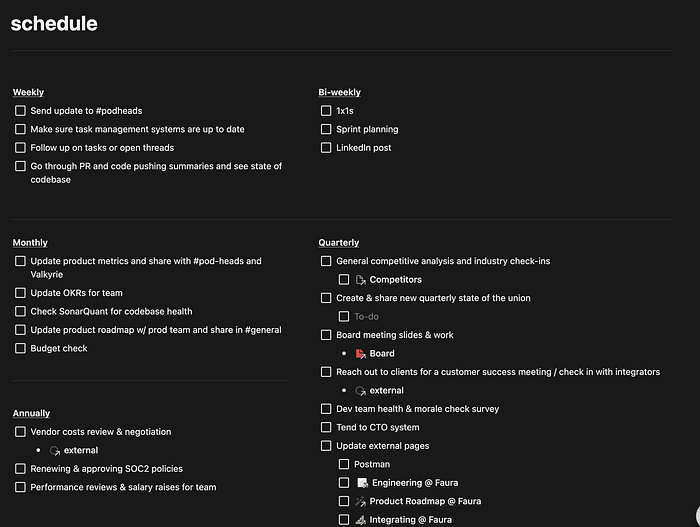
Schedule — Everything I need to do monthly, quarterly, yearly, etc. This is my repeating process checklist. This is relatively self-explanatory. Some of this is just good maintenance, other stuff is things that I need to be reminded of and to keep top of list.
— — —
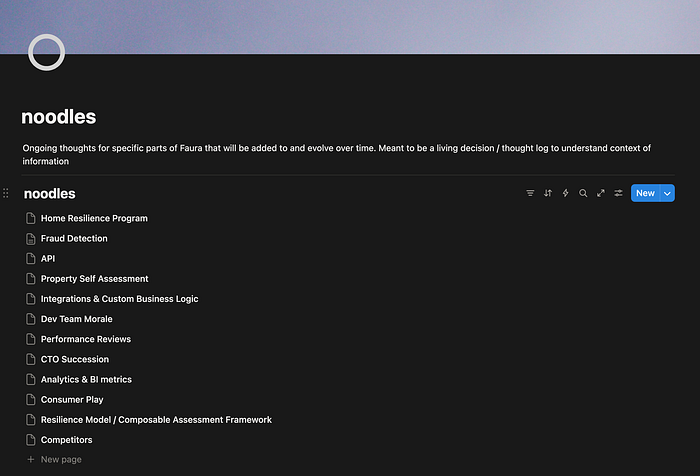
Noodles — These are living documents where I collect how my thoughts on different topics have changed over time. This had no content at time of screenshot, but has become one of the most valuable places of reflection for me. It’s also very hard to understand a decision without context. Being able to keep track of how thoughts have evolved, or of random articles or bits of information go in a chronological order has very much been a game changer for centralizing all of the chaos into concision. This is also where I just sometimes voice transcript notes about things that I can’t get out of my head, just so I have a place to put them and consider them safe.
— — —
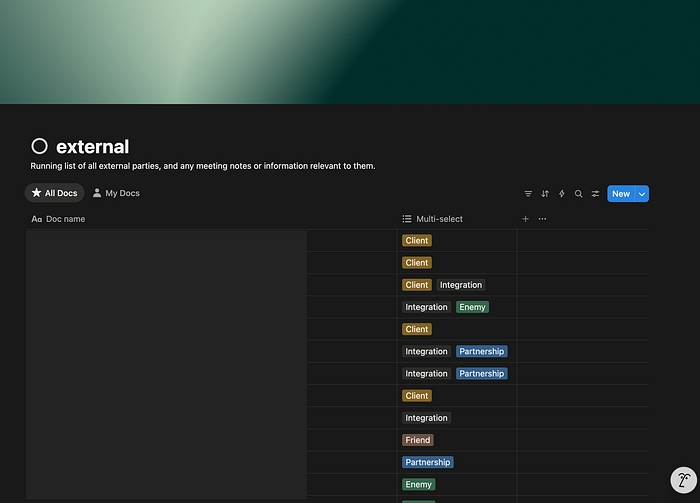
External — Notes and metadata about every external 3rd party I meet / have a relationship with, any relevant information, and all meeting notes.
This is SUPER helpful, because I’m able to concisely share background about partners, advisors, competitors, etc or pull these up in meetings and go through the background of our relationship with them. It’s also beneficial if I need to jump out of meetings and send someone in my place so they have all of the knowledge I do.
I’m not a fan of meeting notetakers. I find they keep me personally from being engaged, and can focus in on the wrong things. Quite honestly, I also get information fatigued. It’s much easier to be engaged and track 3+ bullet points then to go through summaries of so many meetings which just feels like it all condenses into AI word blobs over time.
— — —
Vault — There’s not a screenshot of this one, but I’m sure you can imagine what this looks like. Living documents that I come back and tend to, but also should be kept locked down. These are things like product metrics, burn, performance reviews of team, vendor costs, etc. This is the “grit” of what is actually happening and where the rubber meets the road of the business.
— — —
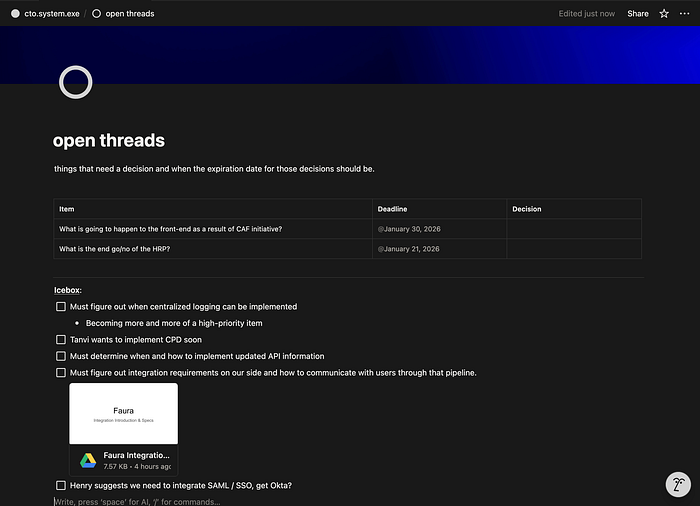
Open Threads — These are decisions that I’ve been notified we need to make or have to come back to. This is my “backlog” where I keep track of major and minor things my team raises. If there’s urgent decisions I need to make, I set an arbitrary deadline to make ANY kind of decision to move something out of unknown → decided. I took the idea of setting deadlines to make decisions from the book “Build” by Tony Fadell. There’s so many things that come down the pipe and being able to just set limits on how long things hover over your head is so helpful.
— — -
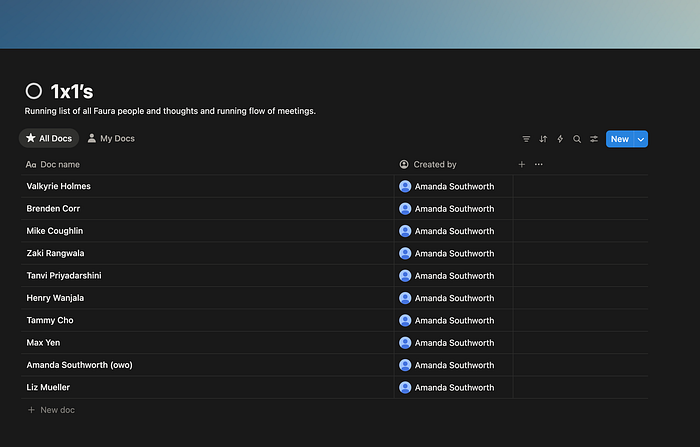
1x1’s — What it sounds like on the tin. A list of everyone in Faura, any documents / notes related to them, and all of my one x one notes. This is also where I track performance & general coaching information. I used to share 1x1 notes with the team based on advice, but I don’t do that anymore. Reason being team wasn’t taking advantage of the shared document to put stuff ahead of time, and I needed to track information anyways. There’s some advice I got that was good on paper, but didn’t actually make it into the real world. Not because it’s not good, but just because it wasn’t worth our time to do.
In a startup, everything is urgent, and in your control, and also out of your control at all fucking times. Above a system, it’s important to have a way where you can work that gives you back a small crumb of control and organization as you face what you’re going through.
Organization doesn’t help incredibly pressing decisions, but it keeps you moving forward long term and means you’re not burning out backwards trying to build context, process, and history from nothing. Sometimes, that bit of effort day to day is what keeps you and the team sane.
Having a document with bullet points about a partner to share at the beginning of the integration, or a pre-set schedule when you’re running on no sleep, or a document to just spill all of your thoughts into when your brain is going a thousand miles an hour can be the glue that holds you together.
It’s those little edges: organization, empathy, working with smart people, and focusing on a problem that is life or death (literally for Faura) that gives you a chance to survive, and maybe even change an industry while you do it.