
- Published on

all software is a product of pressure.
- Authors
- Name
- Amanda Southworth
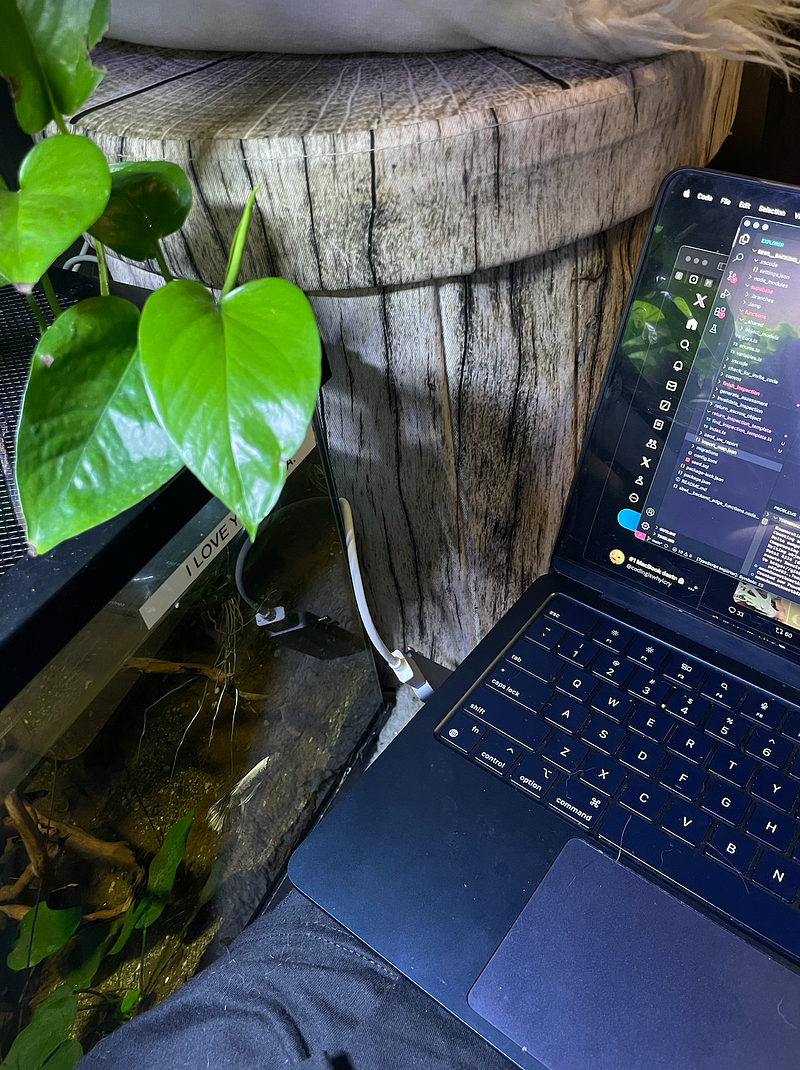
My fish programming with me.
I’ve been thinking a lot about how our internet has evolved, and what it means for us day to day. On Twitter, I’ve been hearing comments like, “The internet is terrible”, “where have all of the fun sites gone”, and so on.
So, what shapes software? What does the software we use and have access to say about us? What can we tell about a company based on the software it creates and sends out?
All of these questions can be answered by pressure. Pressures of the individual developers, the greater market, the changing complexity of building websites, and most importantly: the pressures to fit our digital world into our real one.
return 1) The developers themselves
This is probably the easiest, and most clear pressure to see to an end user. Things like bugs, UI design, and software quality come from developers, and the tools they’re given. In bigger organizations, this is the technical part of the company. More than developers, it will include designers, people in charge of drafting product features, people responsible for cybersecurity and infrastructure, people responsible for QA, and more.
What developers are given really reflects the context of the business funding it. If a company has little to no money for developers, or patience for investing in technical infrastructure, this is when you’ll see bugs, slow launches, oversights, constant outages, spelling mistakes, and so on.
Enterprise / consumer software is often incredibly complex, and building those giant codebases has more in common with a house than they do a website from the early 2000’s. This is because building good software at scale is incredibly hard.
To illustrate this, let’s imagine a website. Let’s take a developer named Kuma, who is building two versions of a landing page. One, he’s showing to his 5 Rilakkuma bear friends. The other is being commissioned by Jeff Bezos to be implemented to everyone who goes on Amazon.
The low scale software would probably need:
- An HTML page with the content, and some embedded CSS
- A domain name
- A hosting platform
- A Sendgrid account to send an email to the people who want to sign up. Because it’s small scale, Kuma can theoretically put this in the front-end even though it’s not secure, because Kuma doesn’t have self esteem and doesn’t assume his friends will share it.
That’s it, give or take. Kuma will send it to his friends, and because they are a small group, there’s little to no variance in what they are looking for, or what they need.
Contrast this with a million+ user site that Jeff is counting on to make up Blue Origin losses.
The high scale software would need:
- The HTML page
- CSS that includes localization
- Localization content (this is every piece of your website translated into a new language)
- WCAG 2.1 compliance (this is how you build accessible software to confirm people with disabilities can use it)
- Private domain purchasing, often in bulk through a different department. Companies have people who buy every available and related domain so domain squatters can’t use it, and they get it from a 3rd party to hide their address / future business moves.
- A backend, potentially with fleshed out dev/ops infrastructure. This can include a load balancer to manage all of the people putting in their emails, a database of all of the emails, an API endpoint for the sendgrid account, more confirmation emails in all of the languages, and logging of possible errors or downtime that may occur.
Wow, that’s a lot.
But, before it can even go live, it needs other people besides Kuma to validate the software before it launches. If not, it could become a failure and embarrass Jeff, and he doesn't need that after those Saudi Prince texts.
So, Kuma will go through more rounds of development with feedback from:
- Validation and QA testing on the pages to ensure proper functionality and no bugs. Someone needs to go through all of the languages to confirm every component translates correctly, and all of the different possible browsers someone can use, and all of the different ways someone with disabilities can use a website.
- Potentially a cybersecurity tester to make sure someone can’t spam a bunch of emails, hack into the email database, or DDOS the site.
- Legal review to make sure there is legally allowable marketing claims, a privacy policy, and potentially a cookie pop up.
- Design review from the design team to check to ensure brand integrity, compliance with design system rules, and so on.
- A bunch of executives who haven’t touched a codebase in 20 years who just want to add comments in the name of ‘management’.
The end piece of software says a lot about the developers (and other technical teams): who they’re building for, how they’re told to solve problems, what kind of resources they’re given, and if they are able to navigate solving complex development problems amidst a business that cares about making money more than building beautiful and efficient things.
This is also why diversity in technical teams is such an important issue. Because the work served to millions, reflects a small group of people within that corporation making the decisions on their behalf.
return 2) The business context of the people putting out the software
You can tell what’s important to a business based on how much effort they put into specific pieces of their software. Conversely, you can tell how much certain regulations allow software companies to grip their clients by the balls and torment them.
Case in point is EPIC, a Electronic Health Record system used by most hospitals in the United States. It’s widely considered to be an absolutely terrible user experience by most physicians, and patients probably have died because of terrible UX, resulting in missing information.
Yet, it is still the market leader and probably will be until an asteroid hits. Software that is more entrenched in regulatory protections or data burdens tends to be worse, because if it’s too hard to transfer data, clients CAN’T switch. If a piece of software is old and is still a market leader, it’s probably because it’s entrenched in ways you can’t see.
On the other hand, software sites that have genuinely no real barrier are constantly changing in and out. Think of the constant iterations of anonymous question apps, mental health / mindfulness apps, etc. If you see the same versions of an app coming and going with no real concrete grip, there is no value proposition there strong enough to build a dominant market player.
There’s nothing to really ‘grip’ onto, and so no formal product is ever made. Think of: ‘why do we not have digital business cards!’, and it’s because it’s an easy piece of software with no grip. There’s already LinkedIn, QR codes, and so on.
Most easy to program things are not really worth anything business wise. Some aspects of software are profitable and highly efficient, others are completely left to the wolves, even in the same website or ecosystem.
Apple’s landing page is highly polished, because it’s their most trafficked page. But, if you’re an iOS developer like I used to be, you could easily go and find pages that were last updated in 2007 in some buried developer tools. Why?
It doesn’t make financial sense to go tell your 300k+ year designers and programmers to revamp an old piece of documentation buried deep in App Store Connect.
The way that businesses promote their employees reflects in software, too. That’s why Google has many projects that are started and then killed off, seemingly with no consequences or change in incentive.
What businesses incentivize, or don’t care about, or are plainly shows in the software we see around us. Often times, early stage startups will ship fast but with buggy code, consistently iterating design, and little to no attention to accessibility. Later stage companies will still ship fast, but with more layers of QA, eyes on the software, but at the cost of innovation for fear of losing market dominance or brand credibility.
Business circumstances shape software from the ground up. It determines what gets built, who builds it, what gets maintained, and what’s worth the details or the lack thereof.
When you ask yourself, why is this software doing XYZ? You can solve it by working backwards.
return Companies aren’t releasing software because it works for their customers, companies are releasing software because it works for the customers AND the companies. And that reflects in the developers and what they’re told to do, which is then reflected in the finished product.
Think of Twitter (I will not be calling it X), who was purchased at an overvalued price and then immediately laid off a fucketh ton of people to reduce burn in order to make it profitable. The death of features, curation, and content moderation are immediately apparent to anyone on the platform who used it before and after.
In a world where developers cost money, anything that’s implemented has a reason behind it.
return 3) The needs of the people using the software (and funding it)
To put it simply, building good shit for a lot of people is hard. It costs money. And it requires a lot of attention to detail and cross co-ordination behind teams. Often, what’s behind the ‘there is no fun place on the internet’ is the fact that building high-scale software means needing lots of money, and the people who give lots of money have specific demands.
In the case of the tech industry, this is VCs. Otherwise known as venture capitalists, and they often provide the bulk of funding. VC’s want very broad, very profitable software companies. This is partially why we have the death of niche software, and the rise of addicting software. Most VCs know that their bets are asymmetric, and that a lot of startups fail. So, the ones that don’t fail need to be huge, huge successes. From their perspective, it makes sense to only go for companies that have a Total Addressable Market (aka how much money you could make) of over a billion dollars.
There is no large scale money to be made on a forum about Canadian Aquarium enthusiasts. There is a lot of money to be made in the digital equivalent of an ELF Bar called TikTok.
VCs and shareholders, as well as the S&P 500 are an undeniable force in what lands on our screens. You can thank them probably, for YouTube banning Adblockers, for ungodly amounts of ads, and probably for TikTok shop. People who provide money want it back, and companies have a fiducary duty to shareholders to act in their financial interest.
Beyond VCs, companies can take on debt, open lines of credit, and have access to other financing things that require them to be in good standing and to be bringing in money. You often need money even if you’re profitable, because payroll and other expenses are consistent, and customers have periods where they will pay later, or won’t pay at all.
Debt and VC money allows companies to even out these bumps so everyone gets paid and they can scale before they have the cash on hand, at the cost of a lot of effort being pushed to monetize and maximize everything about a product.
VCs and other financiers also can subsidize the cost of accquiring new users in the name of growth. That’s why Uber and Doordash (along with other platforms) grew so fast, but still couldn’t make money.
VCs will sometimes help companies artificially lower the prices of goods to gain users, only to have them become bound in the platform ecosystem and raise prices. This is what Netflix has done with their content library, and is what a lot of streaming services (which are not profitable although they have insane pricing) are wanting to do soon.
Below the shareholders are the only other people that truly have power to change features and the way software works: users
return Software is nothing if people are not using it.
The software we use aims to strike a balance in between growth, shareholders, and the people who use them.
But, users hold the most power. Ad based platforms need eyeballs, and engagement. Subscriptions need people to buy them. If you don’t engage with a feature, some person is reviewing the analytics to see why that is.
Underpinning most software is a very detailed layer of analytics that recreates the user’s journey. The success of features is determined by engagement, how many people like it, how long they like it for, and if they come back to it.
These analytics quantify user sentiment, and answer the question: ‘Are people using this?’. These analytics also narrow down what stays in the product, what goes, and what’s on the block for redesign.
return 4) The world where software takes place.
The software we use is highly coupled to our world, and we can use software that’s downloaded often as a reflection of our values at scale and what we care about.
TEMU, which has been topping the app charts, tells us that we deeply deeply care about getting a good deal on products (even at the detriment of others). It also tells us that gamification of our e-commerce sites works.
Let’s break down some key things that TEMU utilizes.

Temu’s landing page has a banner that constantly revolves, telling you that you get free shipping, you have a delivery guarantee, and that you should get the app.
The main banner is seasonal, which signals limited edition. It also signals first and foremost, the amazing 90% off sale that’s happening. There is ALWAYS a sale on Temu, and most of the time it’s on this banner. Below the banner, you another little box telling you that you’re secure, safe, and that your deliveries will get there! We are not a scam, they scream!

This is the most ‘gambly’ esq component on the site, and something that Amazon uses for their special sales. For each item, it shows the price. Most items are discounted from their original price.
It also shows stars, but most of the stars are not for that product specifically. The stars shown are for the seller, but the misleading placement makes you think others have bought it and given it a good review.
The quantity bar tells you how much it has left to go, before the item goes out of stock. TEMU’s business model does involve working with warehouses to make small batches of products, which can sell out easier and quicker, leading to people purchasing more and thinking there is scarcity.
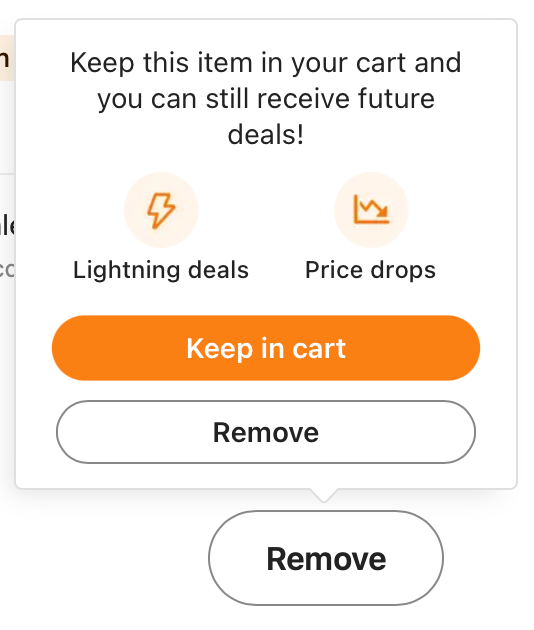
When you click remove on an item in your cart, it doesn’t remove it. Instead, it pleads with you to keep it in the cart, and even highlights ‘KEEP IN CART’ as the primary button to press. You have to confirm remove to delete the item.
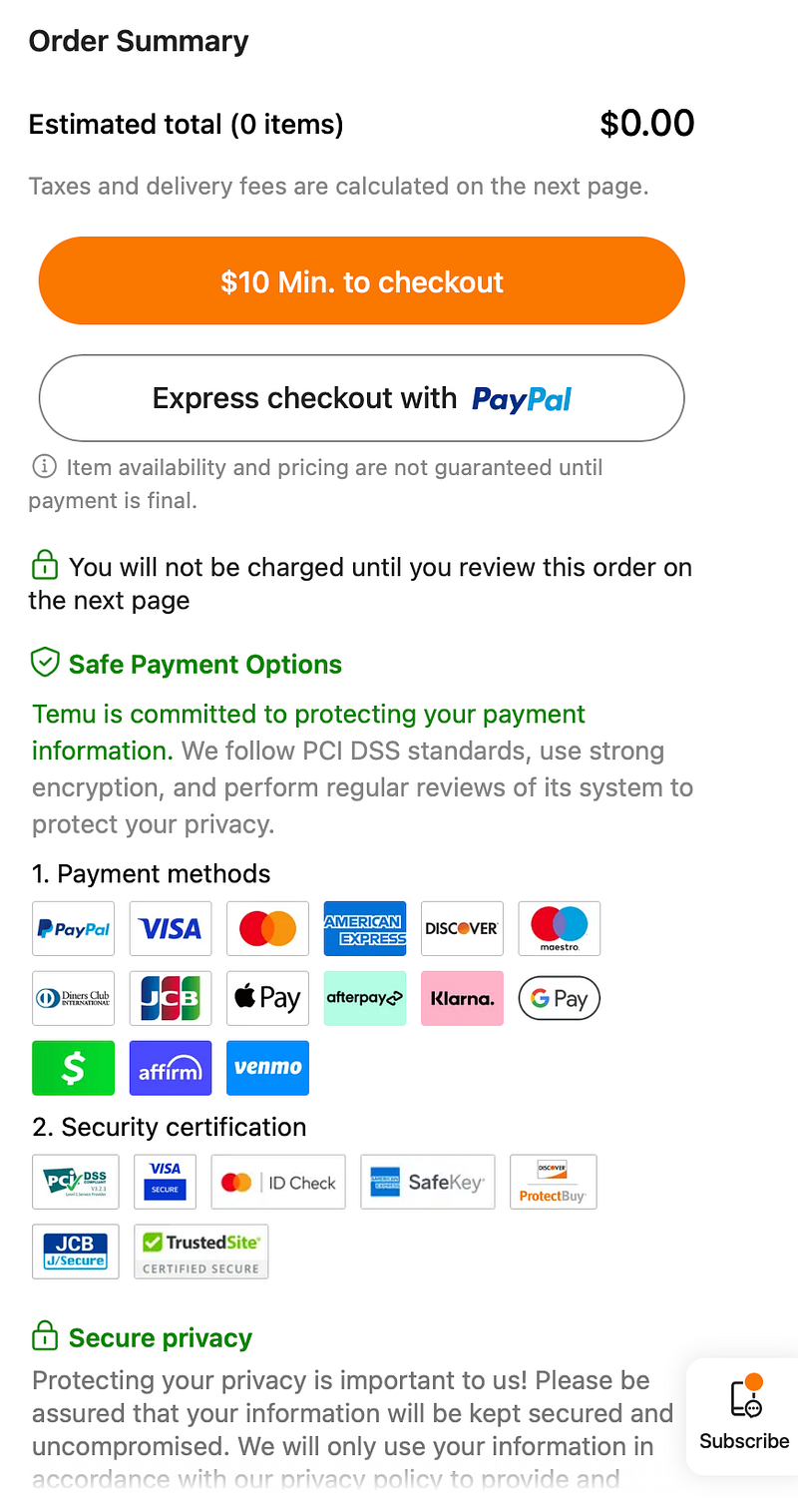
Something that caught my eye was the fact that TEMU accepts almost EVERY SINGLE payment option. Most companies will partner exclusively with Klarna, or Affirm for better partnerships and rates.
Not TEMU, it will not take chances. It again shows that you’re secure, and safe, and have nothing to worry about. Now, fork over your money broke bitch. TEMU needs lots of people to purchase lots of things because their margins are so thin. So, they probably told their technical team to make buying as easy, and as fast as possible.
return They use every sales trick in the book, and they use small digital design tricks to push you to trusting the site, making the sale quicker, and not giving you ANY reason to say no. They combat any rebuttal before you can even raise it.
The rise of dating apps, delivery apps, generative AI software, and more shows that we desire a world built out of content and convenience. That we’re willing to sacrifice privacy and money for ease, and for a few more seconds back in our day.
The world, what it does to us, and what we do to each other trickles down into what makes software viable in the first place. This is the first thing that people look for (or should) before building software: what do people want? Or, maybe in a more cynical way, what can we convince people they want?
Ultimately, the software that we have and that lasts in our public consciousness is a reflection of everything that created it: the developers, the business, the users, the financiers, and the world and all of its’ complexities in which it’s deployed.
Every day I use software, and I wonder how it came to be. I like to dissect it, to see what decisions were made, to peel back the design and layout to see what it’s conveying.
When we begin to analyze software more as an artifact and less as a user, we’re able to understand the intentions of what it wants us to do more.
Code is not made in isolation of our world, but in the hands of it. If we want to be more mindful of the software in our lives and how it effects us, we have to essentially autopsy these pieces of software to see if they’re acting in the interest of us, or the company that gives it to us. Oftentimes it’s both, but it’s increasingly the latter.
Sure, nothing comes without a price. But, in a world where
return Shouldn’t we know about the origins of the software we use to learn how it influences us? The pressures that create software are inversely, the pressures they pour down onto us.
The pressure for companies to make money is reconfigured into the pressure to give data, to purchase, to consume content, to filter our face to attain beauty standards, to swipe continuously through engagement bait. Our desires are repackaged and sold to us in a digital candy wrapper, even more amplified, intense, and accessible than any way of doing things in the past was. The software we have is human nature, digitized, maximized, and monetized to the tits.
Does it matter if any of it is real? If the stories on Reddit are fake, or the girls on Instagram are puffed up with filler, or if the inflamming comment on Twitter has any basis in quantifiable research? No. In a business where software is driven by people, it’s not about if things are true. It’s about if you believe they’re true enough to stay on a site, make a purchase, watch a video, or pay a subscription.
If it drives conversions, the business is succeeding. Every piece of code, design, or ask to the user says something very clearly. You just have to listen to understand what it whispers.