
- Published on

ai will not save tech for good.
- Authors
- Name
- Amanda Southworth
I keep continuously seeing the argument that generative AI agents will improve people's ability to write and ship more code. Therefore, through some odds and ends, we should theoretically see more non-profits or individual developers be able to manage and maintain social good software products. To be clear, this is not something I see directly stated often. It's moreso things I see posted on LinkedIn by thought leaders in the tech for good space, or a suggestion my father floats to me on the phone.
Point blank, I don't think this is the case (entirely). Like most hot button topics, the answer does not lie directly in the tool but in how it is used. Not because AI-code is not helpful in its' own contexts, but mostly because social good software is not stopped due to lack of ideas or the desire for people to create these products. It is mostly the case that it is incredibly hard to create social good software. Beyond creating it, it is borderline impossible to fund and keep it afloat in our world today.
When someone tries to create a new company or a new non-profit around a social good product innovation, they run into 3 simultaneous balls in the air.
- They need to create a new social good program format
- They need to create a software product that adapts that format correctly
- They need to create an operating entity that oversees and manages that software product, sustainably.
In essence, a new founder in the tech for good space is juggling 3 balls in the air. If one of those drops:
- the social good program format does not operate as intended (like AMBER alerts not actually stopping stranger abductions),
- the software product does not adopt the format of the program as intended (like NEDA's Tessa chatbot providing harmful advice to users after they shuttered their hotline),
- or the operating entity that owns the product cannot sustain it long term (like Callisto, the serial predator algorithm that shut down this year after 10 years in market because of lack of funding),
the program is not viable long term.
To be clear: a product that exists and helps at all in our world for any amount of time is a win. But the real issue in the tech for good space is not if these products will exist or can help people, it's if they reach their full potential as a digital product long-term.
AI generated code does not, nor will it, help with these things. More than anything, social good software is not a field that works from being rushed through product development. When we see gen-ai focused development teams in a non-technical organization, or those with the idea that an agent can create a product from scratch, what they often end up building is a generic version of things already within the market.
Social good software already has cut many corners, or is developed by people who don't truly know what they are doing (myself included), and the idea that by handing an AI agent to a non-profit to make them innovative is laughable. Having worked in 2 separate local non-profits that worked to be tech enabled, the question is not: "How can we make our organization tech-forward?", it is, "How do we create a culture of utilizing technology wisely in a way that deeply resonates with what our users and core community will want?"
Many non-profits or social good schemes just slap code or a product on-top of pre-existing processes, to varying degrees of success. But, whether or not a social good product will actually reach its potential depends just as much on the environment where it's been deployed. Does the program have someone who can translate the social good program into a digital counterpart that leverages software effectively? Is there a network of partners around who can truly make this a success from the ground up? Sometimes, but not all of the time.
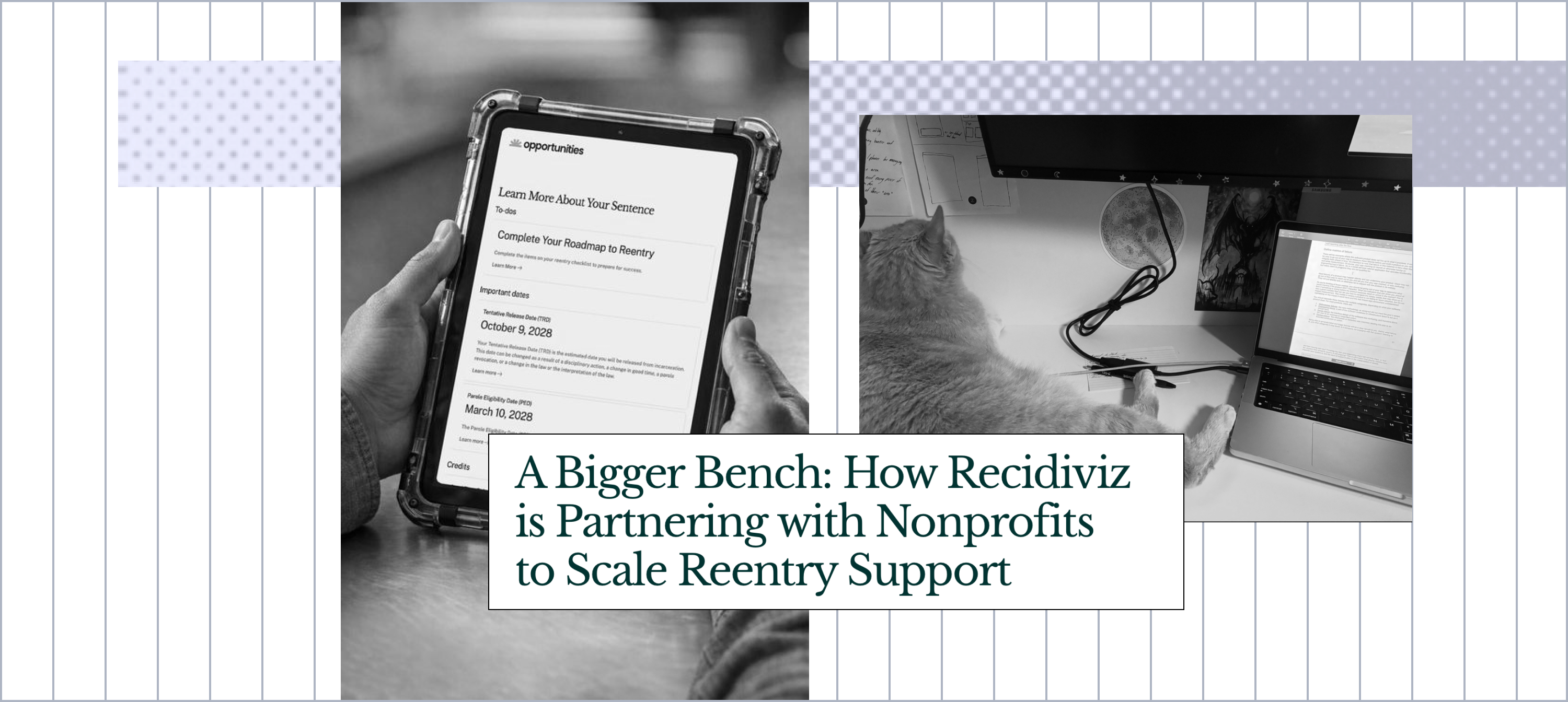
One of the partnerships in the tech for good space that caught my eye recently was from Recidiviz, FreeWorld, Edovo, and mRelief (and other in-person partners). Recividiz builds technology that improves the criminal justice system, Edovo is Khan Academy for inmates, FreeWorld helps people get CDLs, and mRelief helps people apply for food stamps.
.Recidiviz operates a platform called Opportunities that helps inmates find information about their prison sentence. They built a partnership of non-profits above to build a tool that helps people plan for exiting prison, and getting on their feet. This is an incredible product for so many reasons that really made my heart soar when I saw it.
Prison recidivism is an incredibly prominent problem in the United States for so many reasons, one of which is the lack of clear opportunities and support when someone leaves prison. They are stepping back into a world that they have been entirely apart from, and may not have any friends or family to call. Some inmates are being released directly back into homelessness, or other circumstances that bring them back into the criminal justice system.
So, for Recidiviz to build a tool and partnership network that makes re-entry into the world easier is a direct solution to the problem at hand. It is also a primary example of asking, 'how do we use technology to do what it is best at?' as opposed to just, 'how do we use technology?'.
It also shows that a piece of software doing good is not about being able to program more of it faster, or being able to get it to market fast enough. It's about building the bridge of trust with your users and those who are in their lives, enough so you can get a chance to see if your product will help.
There is some ways in which I think AI tooling can help reduce some of the burden of making software accessible, safe, and easy. But, I don't think AI tooling as a whole can solve the true issues that the tech for good space deals with every day.
There is no lack of ideas or products that we can generate: the harder part is building the rails needed in our world to house our products and to make sure they reach their full potential, and that the diagnosis and 'solution' built into the software product is correct in the first place.